Lambir Canopy Walkway
Primary tabs

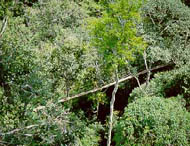
The Lambir Canopy Walkway project was jointly coordinated by Abang Abdul Hamid, an Entomologist with the Forest Department of Sarawak together with the late Professor Tamiji Inoue of the Center for Ecological Research, Kyoto University.
The article from Botany.org written in 1999 (link no longer available):
Professor Tamiji Inoue was born on the island of Awajishima in Japan's inland sea and grew up in Japan's post Second World War rebuilding phase. For his undergraduate studies he took Entomology at Kyoto University's Faculty of Agriculture and having graduated he spent six months on an expedition to Chile and Patagonia, following Darwin's footsteps. His doctorate research, again at Kyoto University, was on Mantis behavior. It was during his post doctoral work that he switched to studying pollination biology through work that originally began as behavioral studies of stingless bees in Indonesia.
In 1991 he was appointed a Chair at the recently opened Center for Ecological Research at Kyoto University. Almost immediately he launched the Canopy Biology Program in Lambir Hills National Park which involved the building of two towers and 300 m of canopy walkway. More recently he began working on a second project at Kuba National Park near Kuching with the intention of building a canopy crane.
In parallel with his research work he was very active in promoting cooperative studies and was largely responsible for establishing the Diversitas in Western Pacific and Asia (DIWPA) initiative. He was also a great populariser of science, which he often combined this with his passion for photography, and contributed many articles, books and school texts on ecology and environmental topics. It was his photograph of beetles pollinating an aroid that was show on the cover of the October issue.
In 1997 Tamiji Inoue was killed in a plane crash in the very same Lambir Hills National Park.
https://www.botany.org/plantsciencebulletin/psb/1999/anno99-1.html (archived link)
 On August 1st, 1960, the Miri General Hospital, which had for long been operated by the oil company with financial assistance from the government, was handed over to the government; with it went the Miri Ferry that connects between the peninsular and town - and the hospital -, all the concession land on the Miri Peninsula south of the Miri Golf Course, and all the houses, roads and utility services within that area.
 Piasau Boat Club is Borneo's premier sports and leisure club. The club hosts activities such as sailing, diving, fishing, rowing, various ball sports as well as parties for both adults and kids.
 Miri Home for the Aged provides shelter, food and care for the aging populace.