The wreck of a Scottish Aviation Twin Pioneer CC.1 aircraft, located at Bario Airport can still be seen today having sat around for more than 50 years.
In late December 1980, strong winds, torrential rain, and heavy swells in the seas, constant heavy rains caused water from the Miri River to overflow into Lutong.
On this Saturday of 25th July 2009, cellphones in Miri lit up with a flood of messages circulating of rumors that a light plane had ditched into the sea off the coast of Miri around noon.
The Lambir Canopy Walkway project was jointly coordinated by Abang Abdul Hamid, an Entomologist with the Forest Department of Sarawak together with the late Professor Tamiji Inoue of the Center for Ecological Research, Kyoto University. ProfessorTamiji Inoue was killed in a plane crash in Lambir Hills National Park.
Built in 1913, and (then) located next to the Miri River and alongside the old fish market, the temple was built and dedicated to the beloved deity by overseas Chinese. Not just a place of worship, but a historical site and a place of interest worth visiting for the architecture and culture.
The HMS Viscount Melbourne was a three-mast, 800-ton sailing wooden ship about 150 feet long and 45 feet wide with brass sheathing that was journeying from Singapore to Macau in 1842 when she blown off course by a heavy storm and ultimately struck a reef in the Laconia Shoals, a large reef complex in South China Sea.
On Saturday, 6th September 1997, flight BI238, a Dornier 228-212 operating for Royal Brunei Airlines leased from Merpati Intan which plied the Labuan - Bandar Seri Begawan - Miri route on a regular basis, crashed in Lambir Hills.
The Old Miri Airport was planned and built in the 1970s, where a demand for a more modern and longer runway was needed to accommodate Fokker 50s and the Boeing 737s for a booming commercial aviation as commercial flying became a more affordable way to travel.
Literally, Sungai Tujoh is translated as the Seventh River or Seventh Stream spelled in the form of Bruneian Malay language. An immigration post was built in the 1960s to control the movement of goods and people between Miri and points west in Sarawak with Brunei, at this "7th river".
Miri River is the body of water that splits Miri Peninsula and the mainland Miri, flowing out to sea from inland, curving at Lutong Town. It is incorrectly marked as Sungai Baong in some online maps, while other references online confused it with Baram River.

 The Lutong Cinema was constructed in 1959, and as one of the first post war cinemas is a source of entertainment for Mirians and Lutongites.
 See what's changed since 1994. Where were you in 1994?
 The wreck of a Scottish Aviation Twin Pioneer CC.1 aircraft, located at Bario Airport can still be seen today having sat around for more than 50 years.
 In late December 1980, strong winds, torrential rain, and heavy swells in the seas, constant heavy rains caused water from the Miri River to overflow into Lutong.
 Nicknamed "Blue Tears" among the locals, this phenomenon is a sight to behold and has sent many people to the beaches in the evenings.
 On this Saturday of 25th July 2009, cellphones in Miri lit up with a flood of messages circulating of rumors that a light plane had ditched into the sea off the coast of Miri around noon.
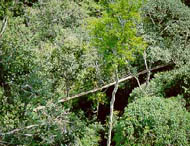 The Lambir Canopy Walkway project was jointly coordinated by Abang Abdul Hamid, an Entomologist with the Forest Department of Sarawak together with the late Professor Tamiji Inoue of the Center for Ecological Research, Kyoto University. ProfessorTamiji Inoue was killed in a plane crash in Lambir Hills National Park.
 Built in 1913, and (then) located next to the Miri River and alongside the
 The HMS Viscount Melbourne was a three-mast, 800-ton sailing wooden ship about 150 feet long and 45 feet wide with brass sheathing that was journeying from Singapore to Macau in 1842 when she blown off course by a heavy storm and ultimately struck a reef in the Laconia Shoals, a large reef complex in South China Sea.
 On Saturday, 6th September 1997, flight BI238, a Dornier 228-212 operating for Royal Brunei Airlines leased from Merpati Intan which plied the Labuan - Bandar Seri Begawan - Miri route on a regular basis, crashed in Lambir Hills.
 The Miri Peninsula is a piece of land that is bordered by water on three sides but connected to mainland Miri, split in between by Miri River.
 The Old Miri Airport was planned and built in the 1970s, where a demand for a more modern and longer runway was needed to accommodate Fokker 50s and the Boeing 737s for a booming commercial aviation as commercial flying became a more affordable way to travel.
 Literally, Sungai Tujoh is translated as the Seventh River or Seventh Stream spelled in the form of Bruneian Malay language. An immigration post was built in the 1960s to control the movement of goods and people between Miri and points west in Sarawak with Brunei, at this "7th river".
 Miri River is the body of water that splits


 Taman Awam Miri or Public Park is about 3km from the city center along the Miri-Bintulu Road.