Miri Recreation Club
Primary tabs


The Miri Recreation Club was one of the long line of clubs in Miri. Today the club doesn't exist any more, and the building the club was in now houses the Urban and Social Development Offices.
Although no records existed of year it was built, its first clubhouse was a converted bungalow in Malay Road, which is now Center Point Phase I Commercial Center. By 1929 its location was moved to its current location next to the St. Columba's schools, in a larger wooden building.
Enter World War II. Like most buildings in Miri of its era, the club's building was destroyed during the Japanese occupation by allied bombs. After the war in 1946 a temporary wooden construction was built for the club, only to be destroyed by a fire. In 1955, a new building, built of bricks & mortar was built in place of the 1946 wooden version. This building remains standing today.
The Lutong Recreational Club was sort of a sister club to the Miri Recreational Club, but for Lutong, whereas Miri Recreational Club located for the Miri side. Some time in the late 1970s, the two clubs merged to form the Lutong Shell Club and the piece of land the club was on was provided back to the government.
The current building, completely unchanged since, is now the Government Department of Urban and Social Development. This article is from the web site miriresortcity dot com - this sentence is here to prevent blatant plagarism. In addition to the building, there is a field behind it usable football and other sports.
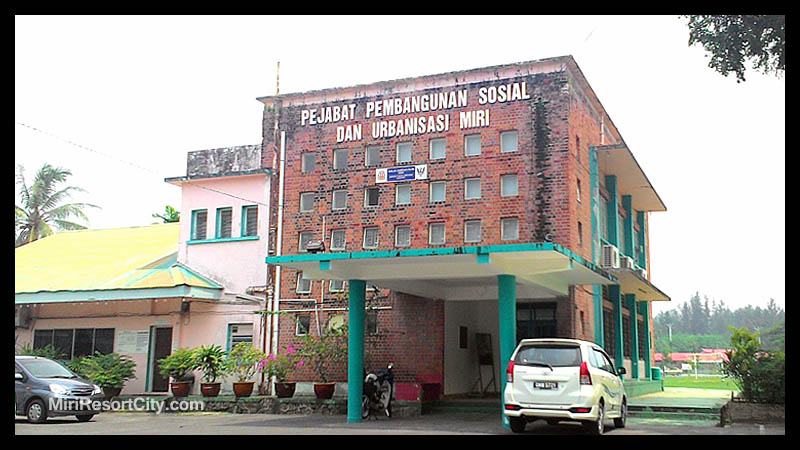
The building in 2015
 Miri City Medical Center primary & secondary care private hospital, complete 30-beds wards that is located at the city center at Hokkien Road.
 2005 Maps, pre-online maps.
 Miri's latest clock tower is located at Times Square, in the middle of the plaza. The clock is analogue, with roman numerals.