Old Miri Airport Tower & Terminal (Decommissioned)
Primary tabs

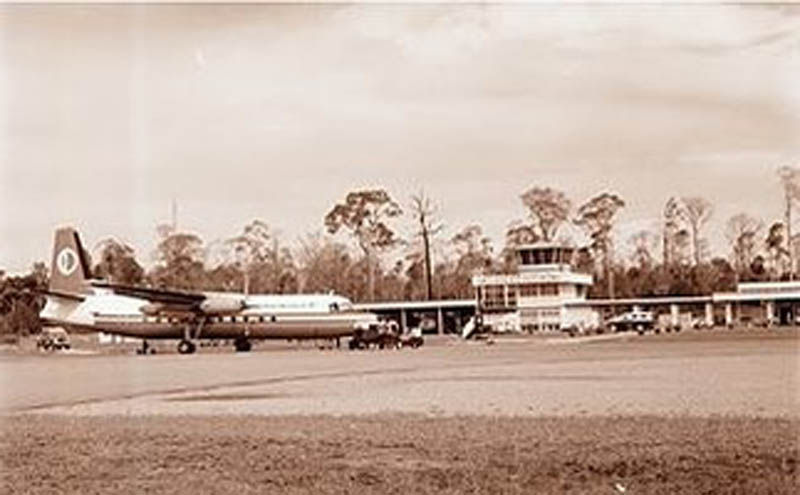
Miri Airport Terminal & tower, post 1972. (NOT Lutong Airfield as far too many people have gotten it wrong.)
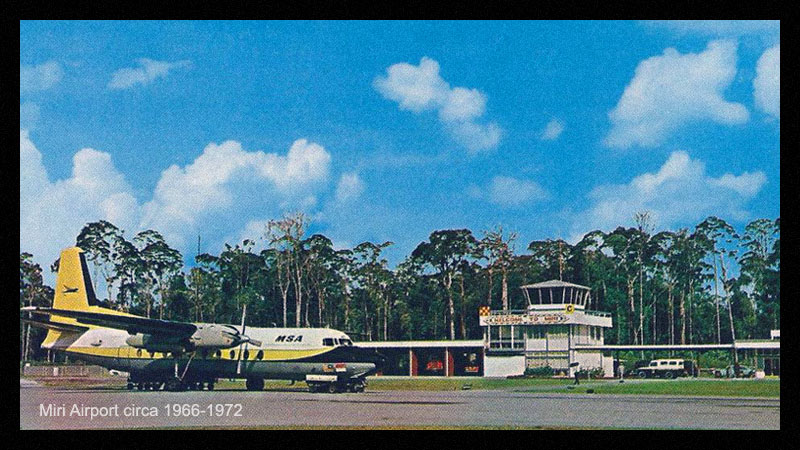
A Malaysia–Singapore Airlines (MSA) Fokker F27 at Miri Airport. This photo definitely dates to within 1966-1972, as MSA only existed during that time period.
The Miri Airport was planned and built in the early 1970s, where a demand for a more modern and longer runway was needed to accommodate Fokker F27s and the Boeing 737s for a booming commercial aviation as commercial flying became a more affordable way to travel. This was because the runway at the Lutong airstrip -which had been the hub of aviation for aviation in Miri in the 40s-60s - was not expandable - being that it was physically limited by the width of the peninsula landmass between the Miri River and South China Sea, and the present site of the airport where there is plenty of land for expansion was selected for the Miri Airport, where it is in use up until today.
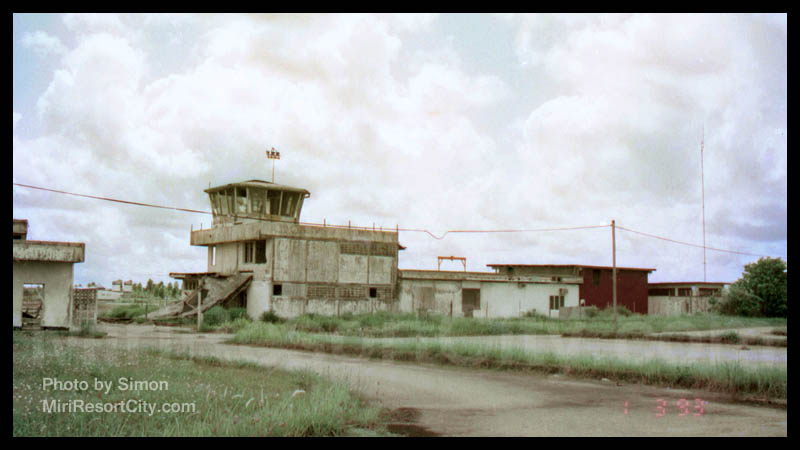
The dilapidated terminal & tower building, in 1993. Photo courtesy of Simon
As with most buildings of the 70s the old airport was not air-conditioned, and had a relatively small terminal meant for Fokker F27 flights. Eventually as Boeing and upgraded Fokker F50 flights became more common, a new terminal was needed to accommodate them, so a newer, larger, two-story terminal was built a bit further south down the runway in the early 1980s, which itself was demolished for a third upgraded terminal by the turn of the millenium. This article is from the web site miriresortcity dot com - this sentence is here to prevent blatant plagarism. The old terminal/tower functioned to handle other tasks for a while before it was abandoned and torn down. Today, hangars to house helicopters for offshore and flying doctor flights are built on the site of the old tower and terminal building.
Its original runway had been extended several times since then as modernization and improvements were added to become what we now recognize as the modern Miri Airport.
Many publications and online sites have confused the images of this old terminal with the Lutong airstrip. It's important to carefully check the details and information provided by sources to ensure accuracy and prevention of perpetuation of inaccuracies.
 Always colorful and full of vibrant patterns, the Kek Lapis Sarawak are a sight to behold just sitting in its dish awaiting to be eaten.
  Piasau Camp was a residential area built in the 1950s for Sarawak Shell for its employees, located on a stretch of the Miri peninsula adjacent to Lutong south from the Lutong airfield.