Miri Civic Center
Primary tabs

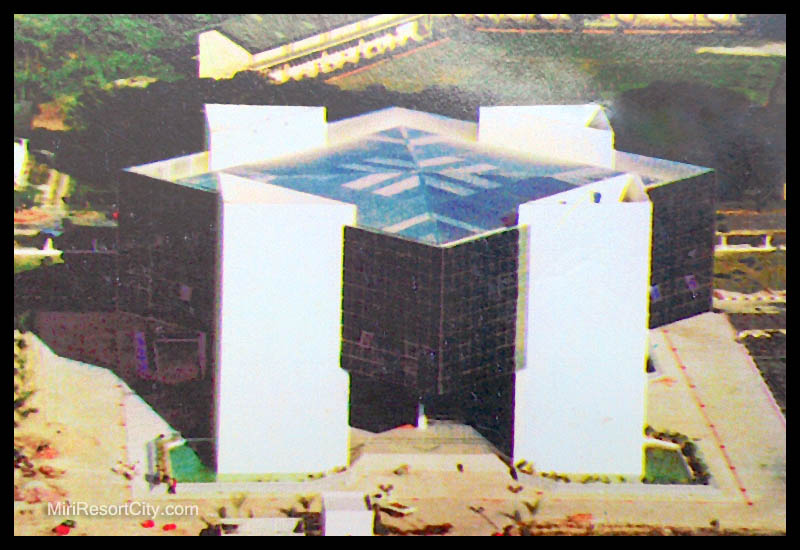
The Civic Center building, taken just after completion.
Completed in the late 1980s, Miri Civic Center functions as an exhibition foyer and amphitheater on the ground floor, holds the Miri Public Library on the second floor, and is a multi-purpose hall for various social functions such as wedding parties, concerts, large conferences etc. The seating capacity allows up to a thousand dining tables.
Its design is reminiscent of an oil-rig platform when view from ground level, with four huge pillars supporting the upper floors rising from water features at the base. When viewed directly from from the air, it has a shape of an octagonal star. The pillars are white in color and the upper floors are covered in blue-tinted glass windows. It makes for a recognizable landmark near the City Fan.
The Civic Center connects to the first phase of the City Fan, a walkway that connects to the open air amphitheater at the center of Miri City Fan.
#miriciviccenter
 Lutong is Miri's first major satellite township, and one that is the heart of the oil and gas operations.
 Luak Bay Food Court is a food court that opened in 2015 alongside Luak Bay Road just off the Miri-Airport Road 'Seahorse' roundabout. The food court is located in between two shop houses and features muslim & other local foods and drinks.
  Gawai Dayak is an annual harvest festival that is celebrated by Sarawakians, Borneo on 31 May and 1 June. It is a public holiday in Sarawak and is a social occasion recognized since 1957.
 Summit Cafe / Gerai Nuba Laya, located at Center Point Phase I serve interesting indigenous dishes.